
Safety Footwear(3)
Filters
-
Brands
-
Use / Application
-
Material
-
PPE Risk Category
-
Footwear Safety Category
-
Color
-
Standards
-
Shoe Size
-
Price
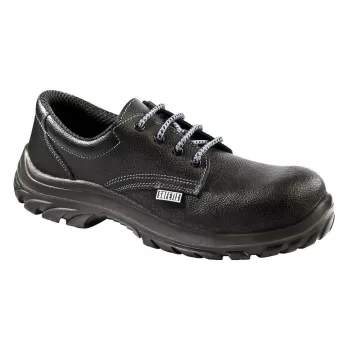


The right safety footwear is one of the most critical decisions in workplace protection. Feet are among the most vulnerable parts of the body on a job site—exposed daily to falling objects, sharp materials, slippery surfaces, electrical hazards, and extreme temperatures.
At yoursafety.gr, you will find safety and occupational footwear for a range of professional needs, including shoes, ankle boots, Wellington boots and clogs. Choose according to your working environment, size and required protective features. Safety footwear certified to EN ISO 20345 includes protective toe caps, while occupational footwear certified to EN ISO 20347 does not require this protection. Check the standard and full marking of each model before choosing.
What is safety footwear, and how are the protection categories defined?
Safety footwear is purpose-engineered protective equipment — not simply rugged shoes. Every pair in our range meets strict European safety standards that define exactly what level of protection is provided. Understanding the classification system helps you choose the right footwear for your specific workplace hazards:
- S1: Toecap protection with a steel or composite (non-metallic) cap, antistatic properties and energy-absorbing heel
- S1P: Everything in S1, plus a penetration-resistant midsole for protection against nails and sharp objects
- S2: Safety footwear meeting the requirements of category S1, with additional resistance to water penetration and absorption in the upper. The S2 marking alone does not mean that the entire shoe is waterproof.
- S3: Safety footwear meeting the requirements of category S2, with additional penetration resistance and cleated outsoles. For whole-footwear water resistance, check for the additional WR marking or the corresponding S7 category.
- S5: Safety footwear made from rubber or polymeric materials, such as Wellington boots, with protective toe caps, antistatic properties, energy absorption in the heel region, penetration resistance and cleated outsoles. Work involving chemicals requires a separate check of the relevant certification and the specific model’s chemical resistance.
- S7: Safety footwear combining the requirements of category S3 with additional whole-footwear water resistance (WR), in accordance with EN ISO 20345:2022. It includes protective toe caps and penetration resistance. The S7 marking does not indicate protection against chainsaw cuts.
- SB: Basic toecap protection without antistatic properties
Additional protection features you will encounter:
- ESD/SD: Electrostatic discharge — essential in environments with sensitive electronics or flammable substances
- HRO: Contact heat resistance for work near hot surfaces
- WR: Water resistance for wet working conditions
- CI: Cold insulation for work in freezing environments
- HI: Heat insulation for work near high-temperature surfaces
Our safety footwear categories
We offer a full range of professional safety footwear to cover every working environment, from construction sites and manufacturing plants to hospitals, kitchens, and forestry.
Work Shoes
Safety work shoes offer the most versatile combination of protection and all-day comfort. Low-cut, lightweight, and ergonomically designed, they are ideal for warehouse staff, logistics workers, light industry, and any professional who spends the working day on their feet and on the move. Available in S1P and S3 ratings to suit different risk levels.
Safety Boots (Ankle Boots)
Safety ankle boots provide additional ankle support compared to low shoes—making them the preferred choice for construction workers, maintenance technicians, and industrial environments. Our range includes standard models as well as specialist options for wet conditions, electricians (dielectric boots), and chemical handling. Available primarily in S1P and S3 categories.
Safety Oxford Shoes
Safety oxford shoes combine a professional, office-ready appearance with full protective performance—ideal for site managers, technical sales representatives, engineers, and supervisory staff who move between office and site environments. Many models are visually indistinguishable from standard leather shoes while providing complete EN ISO 20345 protection.
Wellington Boots & Wellies
Safety Wellington boots are essential for working in wet, muddy, or chemically contaminated environments. Suited to agriculture, fishing, food processing, cleaning services, and any role involving prolonged exposure to water or liquids. Available with and without toecap protection, with non-slip soles and cold-insulation options for outdoor winter use.
Safety Clogs
Safety clogs are the footwear of choice for healthcare professionals, food service workers, and pharmaceutical industry staff. Lightweight, easy to put on and take off, with antibacterial properties and non-slip soles designed for smooth, wet floors. Particularly popular among nurses, doctors, chefs, and cleaning staff who spend long shifts standing on hard surfaces.
S7 Safety Footwear — Protection for Work in Wet Conditions
S7 safety footwear combines toe protection, penetration resistance and whole-footwear water resistance (WR), in accordance with EN ISO 20345:2022. It is an option for outdoor work and environments involving exposure to water and moisture, provided that the specifications of the selected model meet the risks and requirements of the task.
The S7, S7L and S7S markings differ in the type and testing requirements of their penetration-resistant inserts. To select suitable footwear, check the full marking and the manufacturer’s technical documentation.
How to choose the right safety footwear
Selecting the correct safety footwear comes down to three key factors:
1. Workplace hazards Footwear selection should be based on a risk assessment of the specific task. Check whether toe protection, penetration resistance, slip resistance, water resistance, or other protective features are required. Electrical hazards require footwear with suitable electrical insulation certification. ESD, antistatic, or metal-free markings alone do not certify protection against electric shock.
2. Duration and intensity of use For workers on their feet for 8 or more hours, ergonomics and comfort matter as much as protection. Look for footwear with breathable membranes, cushioned insoles, lightweight construction, and adequate width fitting. Discomfort leads to fatigue, which increases accident risk.
3. Industry-specific regulations Many sectors—food production, pharmaceuticals, and electronics manufacturing—have requirements beyond the base EN ISO 20345 standard. If you are unsure which category applies to your workplace, contact us and we will advise based on your specific situation.
Why choose safety footwear from yoursafety.gr?
Certified European manufacturers
At yoursafety.gr, you will find safety and occupational footwear from established European manufacturers, including Giasco, Delta Plus, Jallatte, Dunlop and Lemaitre. Our range includes models for different working environments, with protective features that vary by product.
Safety footwear certified to EN ISO 20345 includes protective toe caps, while occupational footwear certified to EN ISO 20347 does not require this protection. Always check the full marking and the manufacturer’s technical documentation for your chosen model to confirm that its certification and protective features meet the requirements of your work.
Wide range of sizes and styles
From size 35 to 48, for men and women, in a variety of colors and designs. Whether you need a basic workhorse boot or a premium ergonomic shoe for long shifts, you will find the right fit in our range.
Volume pricing for businesses
We regularly supply companies with safety footwear for entire teams. Contact us directly for bulk pricing, product recommendations tailored to your industry, and flexible delivery arrangements.
Fast delivery across Greece
In-stock items are dispatched promptly via reliable courier partners to every part of Greece.
Frequently asked questions about safety footwear
What is the difference between S1, S2, and S3 safety footwear? Category S1 includes protective toe caps, a closed heel region, antistatic properties and energy absorption in the heel. S2 adds resistance to water penetration and absorption in the upper. S3 adds penetration resistance and cleated outsoles. The S2 and S3 markings alone do not guarantee whole-footwear water resistance. Choose footwear according to its full marking, the applicable edition of the standard and the requirements of your work.
Is safety footwear legally required? In many sectors, providing appropriate safety footwear is a legal obligation for employers under EU Directive 89/656/EEC and Greek health and safety legislation. The employer must provide certified personal protective equipment at no cost to the employee. The specific requirements depend on the hazards present in your workplace.
Will steel toecap boots set off metal detectors? Yes. Steel toecap footwear will trigger metal detectors. If you work in environments with security screening—airports, prisons, and secure facilities—choose footwear with a composite (non-metallic) toecap made from Kevlar or fiberglass. These offer equivalent protection without containing any metal.
What is S7 safety footwear, and who is it suitable for? S7 safety footwear provides protective toe caps, penetration resistance and whole-footwear water resistance (WR), in accordance with EN ISO 20345:2022. It is intended for professionals who require these features when working in wet conditions. The S7 classification does not certify protection against chainsaw cuts. Chainsaw work requires footwear specifically certified for that hazard.
When should I replace my safety footwear? There is no single replacement interval for all safety footwear. Service life depends on the model, workload, environment, storage and maintenance. Inspect your footwear before use for wear, cracks, sole separation or other damage. Remove it from service if its protective function has been compromised. After a significant impact or penetration incident, do not assume that it remains safe simply because no external damage is visible; follow the manufacturer’s instructions for inspection or replacement.
How do I choose the right size for safety footwear? Measure both feet and consult the manufacturer’s size guide for the specific model. Try the footwear on with the socks you wear at work. Your toes should have enough room without pressure from the protective toe cap, while your heel should remain secure. Do not automatically choose a larger size: a proper fit depends on the length, width and shape of the footwear.
Protect your workforce from the ground up. Browse our full range of certified safety footwear or contact us for expert advice matched to your industry and risk profile.