Safety Footwear Buying Guide: Choose by Job & Protection
Safety Footwear Buying Guide: How to Choose the Right Shoes for Your Job
Which safety shoes do you need for work? The answer depends on your working environment, the hazards you face, and how well the footwear fits.
A warehouse worker, a construction worker, and a professional working in a kitchen may all spend long hours on their feet, but their protection requirements can differ considerably. Even within the same profession, different tasks may call for different footwear.
This guide explains safety footwear classifications, the features to check, and how to choose a pair that combines appropriate protection with everyday comfort.
1. Start with Your Workplace Hazards
Before comparing designs and prices, consider these questions:
-
Could falling objects or compression injure your toes?
-
Could you step on nails, metal fragments, or other sharp objects?
-
Are the floors dry, wet, oily, or uneven?
-
Do you work outdoors in rain and damp conditions?
-
Are you exposed to heat, cold, electrical hazards, or chemicals?
-
Does your work involve continuous walking, climbing ladders, or standing for long periods?
Your workplace risk assessment determines the necessary protective features. Your job title is a useful starting point, but it is not enough to identify the right protection class.
2. Safety Footwear vs Occupational Footwear: What Is the Difference?
Safety footwear certified to EN ISO 20345 includes protective toe caps tested for an impact of 200 joules and a compression force of 15 kN.
Occupational footwear certified to EN ISO 20347 does not require this toe protection. Depending on its marking, it may offer other features, such as slip resistance or resistance to water penetration in the upper.
Comfortable occupational shoes therefore cannot replace safety footwear where toe protection is required.
3. What Do SB, S1, S2, S3, and S7 Mean?
The table below summarizes the main differences. Always check the full marking and the edition of the standard applicable to the particular product.
| Protection class | Main features |
|---|---|
| SB | Basic safety footwear requirements, including protective toe caps. |
| S1 | Additional requirements include a closed heel region, antistatic properties, and energy absorption in the heel. |
| S1P / S1PL / S1PS | S1 features plus penetration resistance, with differences in the insert type or testing requirements. |
| S2 | S1 features plus resistance to water penetration and absorption in the upper. |
| S3 / S3L / S3S | S2 features plus penetration resistance and cleated outsoles. |
| S4 | Rubber or polymeric footwear with protective toe caps, antistatic properties, and energy absorption in the heel. |
| S5 | S4 features plus penetration resistance and cleated outsoles. |
| S6 | S2 features plus whole-footwear water resistance, WR. |
| S7 / S7L / S7S | The corresponding S3/S3L/S3S features plus whole-footwear water resistance, WR. |
These categories are not a simple scale where a higher number always means a better choice. They describe different combinations of protective features.
What Is the Difference Between P, PL, and PS?
Under EN ISO 20345:2022:
-
P: a metallic penetration-resistant insert.
-
PL: a non-metallic insert tested using a nail with a diameter of 4.5 mm.
-
PS: a non-metallic insert tested using a nail with a diameter of 3.0 mm.
This explains markings such as S1PS and S3S. No insert provides unlimited protection against every sharp object or load.
Footwear certified to different editions of the standard may use different terminology. Compare the full certification rather than relying on a single code in the product name.
Are S3 Safety Shoes Waterproof?
S3 includes resistance to water penetration and absorption in the upper. This does not automatically mean that the entire shoe is waterproof.
If your work involves frequent exposure to water, check for WR marking or categories such as S6 and S7, together with the manufacturer’s instructions and limitations.
The S7 marking does not indicate protection against chainsaw cuts.
4. How to Choose Safety Footwear for Your Job
The examples below provide a starting point. The required features must be confirmed for your specific workplace and tasks.
| Job or working environment | Hazards and requirements to check | Selection guidance |
|---|---|---|
| Warehousing and logistics | Falling loads, pallets, sharp objects, and extensive walking | Consider S1, where it meets the assessed risks, or S1P/S1PL/S1PS, where penetration resistance is also required. |
| Construction and building sites | Nails, debris, falling materials, and moisture | Consider S3/S3L/S3S. For greater exposure to water, check for WR or S7/S7L/S7S. |
| Vehicle workshops and machine shops | Heavy components, metal fragments, and oily floors | Check toe protection, any need for penetration resistance, and outsole suitability for the actual surfaces. |
| Kitchens and catering | Water, grease, cleaning, and prolonged standing | Prioritise suitable slip resistance. EN ISO 20347 footwear is an option only where protective toe caps are not required. |
| Healthcare and cleaning | Slippery floors, liquids, cleaning products, and long shifts | Check fit, cleanability, grip, and any requirement for toe protection. |
| Agriculture and outdoor work | Mud, water, uneven ground, and tools | Consider suitable safety Wellington boots or footwear with WR, depending on the assessed hazards. |
| Electronics and assembly | Electrostatic discharge and mechanical hazards | Choose ESD footwear where required by the workplace’s electrostatic control system, alongside the necessary mechanical protection. |
| Electrical work | Electrical voltage and potential contact conditions | Check the specific electrical insulation certification. S3 or metal-free marking alone is insufficient. |
-
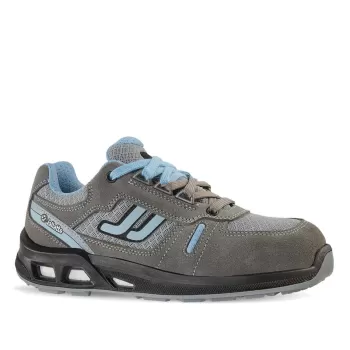 Jallatte LAIA ESD S1PS Women's Safety Shoes S1PS | Infinergy® BASF
-
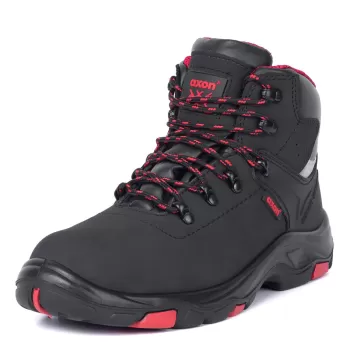 Axon POWER S3S FO HRO SR | Safety Boots with Kevlar Protection
-
 Giasco Makalu S7L – S7L FO CI SR Safety Boot
-
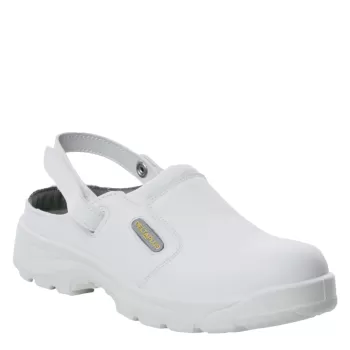 Delta Plus MAUBEC 3 SBEA SRC – Safety Clogs for Food Industry
-
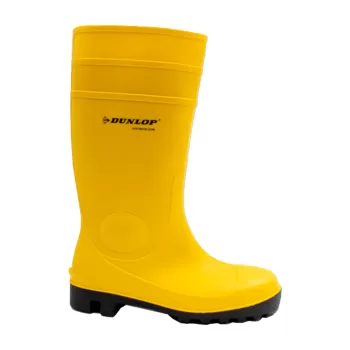 Dunlop Protomastor S5 SRA PVC Safety Boots
Electrical Work: Why ESD Does Not Mean Electrical Insulation
ESD footwear helps dissipate electrostatic charge in a controlled way. It does not, by itself, provide protection against electric shock.
Similarly, footwear without metal components is not automatically electrically insulating. Electrical hazards require appropriate specialist certification and selection based on the actual working conditions.
5. Additional Markings Worth Knowing
The main protection class is only part of the information. You may also see the following markings:
| Marking | What it refers to |
|---|---|
| SR | An additional slip-resistance test under the 2022 edition of the standard. |
| WR | Whole-footwear water resistance. |
| WPA | Resistance to water penetration and absorption in the upper. |
| FO | Resistance of the outsole to fuel oil. |
| HRO | Resistance of the outsole to hot contact. |
| CI / HI | Insulation against cold / heat. |
| AN | Ankle protection. |
Under the 2022 edition, the previous SRA, SRB, and SRC markings have been replaced by a different testing system. SR should not be treated as a simple renaming of SRC.
Oil resistance and grip on oily floors are different properties. FO does not guarantee that footwear will resist slipping on an oily surface. Actual performance depends on the outsole, flooring, contaminants, and wear.
6. Low Shoes, Ankle Boots, or Wellington Boots?
The footwear style should suit both your movements and your working conditions.
-
Low shoes: consider these where freedom of movement and frequent walking are important, while ensuring the required protection class.
-
Ankle boots: provide greater coverage around the ankle. However, their height alone does not mean they offer certified ankle protection.
-
Wellington boots: can be practical for water, mud, and frequent washing, provided they have the necessary protective features.
Compare work shoes, ankle boots, and Wellington boots using each model’s full specifications rather than its appearance alone.
7. How to Find the Right Size and Fit
Certified footwear also needs to fit properly so that you can wear it comfortably throughout your shift.
-
Measure both feet.
-
Consult the size chart for the specific manufacturer.
-
Try the footwear on with your usual work socks.
-
Check that your toes are not pressed against the protective toe cap.
-
Make sure your heel remains secure.
-
Walk around and try the movements you regularly make at work.
Do not automatically choose a size larger than your usual footwear. Width and shape matter as well as length. If a shoe feels tight at the sides, you may need a different fit rather than a longer shoe.
For long shifts, also compare weight, flexibility, lining, and breathability. Where a weight is stated, check whether it refers to one shoe or a pair and which size was measured.
8. When Should Safety Footwear Be Replaced?
There is no single replacement interval for all safety footwear. Service life depends on construction, workload, storage and maintenance.
Before use, check for:
-
Worn outsoles and loss of tread.
-
Cracks or sole separation.
-
Tears and damaged stitching.
-
Worn fastenings or laces.
-
Deformation or damage to protective components.
After a significant impact or penetration incident, follow the manufacturer’s instructions for inspection or replacement. The absence of visible damage is not enough to confirm that the footwear remains suitable for use.
Frequently Asked Questions About Buying Safety Footwear
Which Is Better: S1P or S3?
The right choice depends on your working conditions. Both categories include penetration resistance, while S3 adds features including resistance to water penetration and absorption in the upper.
Check the edition of the standard and the full marking before comparing products.
Are Shoes with Composite Toe Caps Metal-Free?
Not necessarily. A composite toe cap does not rule out metal components elsewhere in the footwear.
If you need a completely metal-free construction, look for a statement covering the entire model.
Can I Use My Own Insoles?
Check the manufacturer’s instructions before replacing the supplied insoles. A change may affect fit, clearance beneath the protective toe cap and electrical properties.
If you need orthopedic insoles, look for an approved, compatible solution.
Is a “Slip-Resistant” Description Enough?
You need to know the conditions under which the footwear was tested and whether they are relevant to your workplace.
A wet floor, an oily surface and muddy ground present different challenges. Ask for information on the model’s suitability for your actual working environment.
Find the Right Footwear for Your Work
Start with the protective features your work requires, then compare fit, comfort, materials and price.
Explore the safety and occupational footwear range at Yoursafety to find models by use, size and protection class. For help choosing, contact our team with details of your tasks, working environment and required specifications.